
大秦帝国
Antarctic ice sheet loss temporarily slows due to remote influence of tropical warm pool: Chinese, foreign scientists_我的网站

A | (ECNS)-- In the mountains of southwest China's Guizhou Province, industries once unlikely to be associated with a remote inland region are finding their way into global markets. In Jiangkou County, Tongren, stands what local authorities describe as the world's largest single-site matcha refining facility. Fully automated production lines process the finely ground green tea for consumers at home and abroad. According to local figures, one in every five cups of matcha consumed worldwide is produced in Tongren. The city's matcha products are exported to more than 50 countries and regions, with the industry generating an output value of 750 million yuan ($105 million). For Mauro, a young visitor from Brazil, the industry raised a broader question: how can globally competitive production create opportunities for rural communities? Tongren's matcha industry works with 73 upstream partner companies and around 13,300 hectares of tea plantations. Financial and technical support for growers, alongside links between market demand and production, helps connect local farmers with a wider supply chain. Matcha is not the only Guizhou product reaching international markets. In Jinping County, Qiandongnan Miao and Dong Autonomous Prefecture, local industry figures suggest that one in every 10 shuttlecocks in circulation worldwide is made there. Production is supported by a supply chain extending from goose farming and feather sorting to intelligent manufacturing. "I hadn't realised that some of the key materials used in these vehicles come from Guizhou," said Thai visitor Nim Jiratchaya, whose family owns a Chinese electric vehicle. Guizhou developed an advanced functional materials industry serving sectors including electric vehicles and renewable energy. Digitalization is also changing traditional manufacturing. Guizhou Tyre's intelligent plant was the first in China's tyre industry to join the World Economic Forum's Global Lighthouse Network, which recognizes factories deploying advanced technologies at scale. The facility also uses photovoltaic power, purchased renewable electricity, and waste-heat recovery to reduce emissions. Infrastructure played another role in connecting the mountainous province with wider markets. Nearly half of the world's 100 highest bridges are located in Guizhou, helping overcome terrain that has long complicated transport and economic connectivity. For the visiting Gen Z group, the journey offered a view of China beyond its major cities and coastal manufacturing centres. Tea, badminton equipment, advanced materials, and tyres illustrate how specialised manufacturing, infrastructure investment, and local resources are connecting communities in China's mountainous southwest with national and global markets. 
 。
。

B |
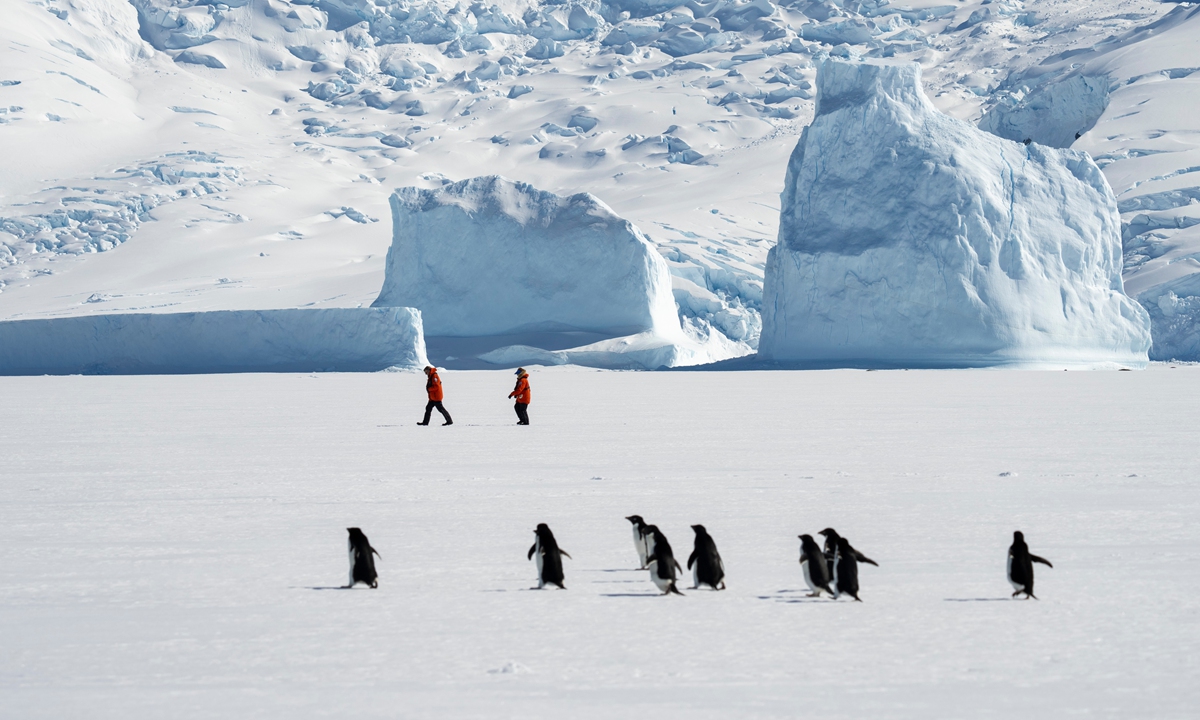
Joint research by Chinese and international scientists have found that the rate of long-term Antarctic mass loss has slowed, driven by sea surface temperature anomalies in the remote tropical warm pool, China Central Television (CCTV) reported on Thursday, citing a statement released by the Institute of Oceanology, Chinese Academy of Sciences (CAS).
The Antarctic ice sheet is one of the major sources of uncertainty in global sea-level rise forecasts. From 2003 to 2024, the Antarctic ice sheet lost an average of approximately 140.5 billion tons each year, CCTV reported.
However, Chinese and foreign scientists have found that the Antarctic ice sheet gained roughly 695 billion tons between July 2021 and April 2023, the largest 22-month mass gain seen in nearly two decades via satellite gravimetry, the Institute of Oceanology, CAS announced on Thursday.
The scientists found out that from 2021 to 2023, sustained heavy snowfall in East Antarctica led to significant increases in snow accumulation, partially offsetting the ongoing ice loss in West Antarctica.
The scientists' research shows that this was caused by tropical ocean-driven atmospheric processes that altered moisture transport pathways and increased snowfall over Antarctica.
The research was conducted by the research team at the Institute of Oceanology at CAS, along with peers from countries including the US, Hungary and Japan. It was published in the academic journal Nature on Wednesday.
According to Wang Yunhe, first author of the research paper and an associate research fellow at the Institute of Oceanology, sea surface temperatures in the tropical western Pacific warm pool remained unusually warm from 2021 to 2023. As one of the regions with the highest sea surface temperatures and strongest heat release into the atmosphere worldwide, changes in this region can reshape atmospheric circulation.
The persistently warmer-than-normal seawater triggered large-scale atmospheric waves.
After reaching the high latitudes of the Southern Hemisphere, the waves reshaped wind patterns and moisture transport pathways. Moisture-tracking simulations show that water vapor from the mid-latitude Indian Ocean fueled heavy snowfall in East Antarctica, leading to a recovery in ice sheet mass.
Observations and climate simulations suggest that such warming events occur roughly once a decade. But these temporary pauses are not enough to reverse Antarctica's long-term ice loss. The West Antarctic ice sheet continues to shrink, while parts of East Antarctica remain increasingly vulnerable to warmer ocean waters melting ice shelves from below and speeding the flow of glaciers into the sea.
The study shows how persistent warming in the tropical warm pool can contribute to the recovery of Antarctic ice-sheet mass, highlighting the role of East Antarctic atmospheric circulation in connecting tropical climate shifts with changes in the ice sheet. The findings point to a previously overlooked climate link between the tropical warm pool and East Antarctica, offering a new perspective on how distant climate systems may shape the continent's future.
Global Times
。
Current article:http://g9i2q.guaxiazaopinduan.cfd/wbma3n/fe5m9.html
Published on:13:09:51
我的网站最近更新
- 湖南裕能:7月以来下游需求依然旺盛 公司处于满产状态
- 恶意罚款
- 斯基拉:恩佐正推动离队去曼城,曼城有信心1.3亿欧与切尔西谈妥
- 中菲面临摊牌?双方都在向黄岩岛集结,央视一天内,连发三条新闻
- Instagram Reels: पापा की परी को भरना पड़ा 11000 जुर्माना... बाइक से स्टंट करते रील बना रही थी युवती, Bihar Police ने सिखाया सबक
- 천안 아파트서 이삿짐 사다리차 넘어져…초등생 중상
- 真在偷听!一聊啥手机App就推啥,上海市政协常委:处罚太轻!主管部门回应
- 2026年度电影总票房突破275亿
- 中日英联手抛售美债,特朗普威胁出动美军“救市”,王雨田观察,原创 中日英联手抛售美债,特朗普威胁出动美军“救市”
- 강원도 산업용 전기요금 8% 인하…정부·한전 지역 요금제 공개
- 广东信宜:文明生沃野 心田沐新风
- 【观点】正信期货:锌价暂有突破震荡区间势头
- 樊振东陈梦领跑世界排名 国乒将出战首届WTT冠军赛
- 科创板股票可以跑量化策略吗?qmt、ptrade量化终端均可适配!
- 马塔担任颁奖嘉宾,为老队友B费颁发PFA赛季最佳球员奖杯
- 生意社:2026年8月26日金川镍出厂价上调
- 美方称敦促中国配合针对伊朗的经济制裁 中方回应
- 比亚迪何志奇:车越做越大,估计再过几年轴距 2.8 米以下的车都会消失
- 暖池塘镇组织开展防火宣传活动
- 上周末又有30多个医疗和礼拜场所收到威胁邮件,警方正在全力追查
- Vicky Kaushal and Katrina Kaif Mark Four Years of Marriage With a Heartfelt Anniversary Post
- 乌克兰爆发反新动员法骚乱,卡车司机封锁基辅-敖德萨高速公路!
- 郑州尖峰眼科:从权威专家到价格透明,一份全面的摘镜指南
- 交易达成!1换1!哈登回归!牛啊,冲击两个NBA历史第一
我的网站热门资讯
- 台风“白海豚”或于今晚到明早在浙江沿海登陆 浙江启动Ⅰ级防台风应急响应
- 양기대, 국토부서 1인시위…“신천~하안~신림선 제5차 국가철도망 반영해 달라”
- 诺辉健康“造假”内幕:找环卫工人买粪便,一份样本拆成多次检测
- Fire partially collapses parking structure at London's Luton Airport
- 全网热议“房屋养老制度”,新加坡人纷纷表示……
- 微软 AI 智能体系统 Aion 曝光:以 Copilot 为核心、重塑桌面体验
- Mother bear with 2 cubs is shot dead, sparking outrage in Italy
- 迪马:蒙扎希望先租后买罗马后卫齐奥尔科夫斯基,球员愿意加盟
- 新易盛:2026年半年度净利润同比增长90.98%
- Kartik Aaryan’s Tu Meri Main Tera Main Tera Tu Meri Opens at Rs 8.46 Crore on Day 1
- 营销文案引争议 德芙深夜发文致歉并启动全面整改
- 黑龙江大庆:在高新区、萨尔图区和龙凤区继续实行5天临时性管控
- 抢小米YU7必看!购前准备攻略来了!
- New COVID Sub-Variant BA 2.75 Detected in India, WHO Says
- R星已彻底癫狂:错把《心之眼》当《GTA6》举报下架
- 宁夏一高校宿舍配冰箱、智能马桶和密码锁,校方回应
- 舅妈在外公灵堂不下跪被外甥打断6根肋骨!外甥获刑6个月
- 2025香港车博会:广汽量产多旋翼飞行汽车首发 AION UT香港首秀
- 逃离的不是朋友圈,是朋友
- 【廉韵润心】知法于心 育幼于行——杭州市文澜幼儿园《中华人民共和国学前教育法》专题学习暨集团师德培训
- Akhanda 2 Collections: Balakrishna’s Film Registers Promising Box Office Haul of Rs 61 Crore
- Organised crime groups' influence increasing: Jurgen Stock
- 不止好运!慈溪老兵的宝藏体彩店,藏着最暖的烟火温柔
- 邓亚萍点评雨果夺冠:雨果打得尤为出色,小将林诗栋也是尽力了